Best VHF Radio for Boat: Essential Marine Radios for Safe Navigation
When choosing a VHF radio for a boat, reliability, durability, and clear communication are paramount. This guide highlights five top options suited for different boaters—from recreational skippers to commercial crews—so you can pick the model that best fits your needs and operating conditions.
| Product | Best For | Key Benefit |
|---|---|---|
| Uniden UM385 | General boating, all US/International channels | DSC, NOAA Weather Alert, rugged design |
| Uniden UM385BK | Compact setup, weather alert enthusiasts | Fixed mount with triple watch and weather alerts |
| Cobra BlueBound 350 | Small to mid-size boats, budget-conscious | Floating, 6W power, NOAA alerts, IPX7 |
| Retevis RM01P | Port operations, coastal activities | IP67, floating, USB-C, NOAA |
| Uniden UM725 | High channel flexibility, GPS/DSC | IPX8, large LCD, Bluetooth option |
Uniden UM385 25 Watt Fixed Mount Marine VHF Radio
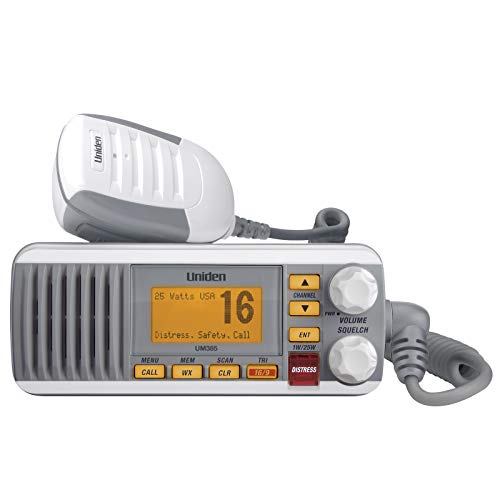
The UM385 consolidates essential marine radio features into a compact fixed-mount design. It supports triple watch, DSC capabilities, and a range of international channels, plus S.A.M.E Weather Alert to warn you about approaching storms. The rugged handheld mic enables quick transmission from the wheel, keeping your focus on the water ahead. Best for boaters who want reliable all-in-one functionality on a single, durable unit.
Best for: Recreational boaters who need DSC distress capability, weather alerts, and international channels in a single device. Limitations: As a fixed-mount model, it requires a mounting space and wiring on the helm.
Uniden UM385BK 25 Watt Fixed Mount Marine VHF Radio

The UM385BK mirrors the UM385 with a fixed-mount design and the same weather alert and DSC capabilities, ensuring reliable performance on international and domestic channels. It’s ideal for boats needing a straightforward, weather-aware VHF radio with robust weather alerting and channel coverage. Best for: Boat operators who want a compact, all-weather VHF radio without additional wireless accessories. Caution: Ensure your installation accommodates the fixed-mount footprint and power requirements.
Cobra BlueBound 350 VHF Handheld Marine Radio – Black

This handheld Cobra radio emphasizes portability and buoyancy with a high-visibility floating core. It offers 6W power with selectable options (1/3/6W), plus NOAA weather alerts and international functionality suited for smaller vessels or temporary needs. Best for: Ready-to-go, space-conscious operators who require a floating handheld for quick retrieval and flexible power use. Limitation: Handheld radios generally have shorter range than fixed-mount models in open water; use as a supplementary device for added redundancy.
Cobra BlueBound 350 VHF Handheld Marine Radio – White

The White variant provides the same features as the black model: floating core, 6W maximum output with adjustable power, and day/night display for visibility. It is a practical option when a handheld device is preferred for flexibility, crewing operations, or as a backup to a fixed-mount radio. Best for: Boats needing a secondary, floating handheld for emergencies or on-deck operations. Caution: Battery life varies by power setting and usage.
Uniden UM725 Marine VHF Radio

The UM725 is designed for broad channel coverage across the US, Canada, and international waters with 1W/25W transmit power. It features the largest LCD screen in its class and NOAA weather channels with alerts. It also supports DSC distress send/receive and includes a speaker microphone. Best for: Boats that require a highly visible display, GPS-ready or Bluetooth-equipped options, and a strong balance of short- and long-range communication. Limitation: Advanced features may require additional peripherals or software integration for full use.
Buying Guide
What should I look for in a boat VHF radio?
Key features to consider include weather alert capability, DSC distress functions, channel range (US/International), fixed-mount versus handheld options, waterproof ratings, and ease of use on a moving vessel. For larger boats, fixed-mount units with a handheld mic are often preferred for quick communication while steering. For smaller or high-deck boats, a floating handheld radio can serve as a reliable backup.
Fixed-mount vs handheld: which is right for you?
Fixed-mount radios offer power stability, extensive channel access, and simple access from the helm. Handheld radios provide portability and a quick grab-and-go option, especially useful on deck or near the stern. Choose fixed-mount for primary communications; choose handheld as a backup or for crew mobility on deck.
Power and range considerations
Most marine VHF radios provide 1W to 25W transmit power. Higher power improves range, especially in open water, but consumes more battery power in handheld units. If you need long-range communication, prioritize models with 25W transmit power and reliable antenna performance.
Weather and safety features
NOAA weather alerts are important for storm tracking and preparedness. DSC capabilities enable distress signaling with location data. Some models integrate GPS for quicker distress replies and for navigation assistance. Consider models with integrated GPS or easy GPS compatibility for enhanced safety.
Additional considerations
- Durability: Look for IPX ratings, water submersion resistance, and rugged construction for marine environments.
- Channel coverage: Ensure the radio supports all necessary US/International channels for your sailing area.
- Connectivity: Some models offer Bluetooth, USB-C, or NMEA compatibility for integrating with other devices.
- Audio quality: Ensure a clear, loud speaker and reliable mic for noisy decks or seas.
FAQ
- Do I need both fixed-mount and handheld radios aboard?
- What is DSC, and why is it important?
- Is NOAA weather alert essential?
- What should I consider about GPS integration?
- Do these radios support international channels?
- How does waterproofing impact use?
Many boaters keep a fixed-mount radio as the primary communicator and a handheld as a backup or for deck use. This provides redundancy and flexibility in different scenarios.
DSC (Digital Selective Calling) allows distress signaling and location transmission to other radios or coast stations, improving emergency response and coordination.
Weather alerts help anticipate storms and dangerous conditions, enabling timely decisions and safety precautions.
GPS integration aids in distress signaling, location sharing, and navigation support. If your duties require precise location data, choose models with built-in GPS or easy external GPS compatibility.
Yes, several models listed support US, Canada, and international marine channels, making them suitable for cross-border voyages and charters.
Higher waterproof ratings (like IPX8) provide better protection against submersion or heavy spray, suitable for offshore or rough-weather use.