Best Onboard Battery Chargers for Boats and RVs
Answering the common buyer question: which onboard battery charger best fits marine, RV, or heavy-use 12V systems? This guide highlights five top options that balance power, waterproofing, and battery compatibility. It helps boaters and RVers pick the right bank count, charging modes, and resilience for harsh environments. The top picks cover 2-bank and 1-bank configurations, including dual and triple-bank systems, with guidance on best use cases and limitations. A quick summary table follows to compare core specs at a glance.
| Product | Bank Count | Total Amps | |
|---|---|---|---|
| NOCO Genius GEN5X2 | 2 | 10 A | Two batteries, marine-duty, mixed battery types |
| NOCO Genius GEN5X1 | 1 | 5 A | Single-battery setups, tight spaces |
| NOCO GENIUS2D | 1 | 2 A | Under-hood, direct-mount maintainer |
| Guest 2707A | 2 | 8 A | Marine-grade 2-bank with IP67 rating |
| FirstPower Pro 2 Bank 5X2 | 2 | 10 A | Sealed, 24/7 charging for SLA/Li, both banks |
NOCO Genius GEN5X2: 2-Bank 10A Onboard Charger
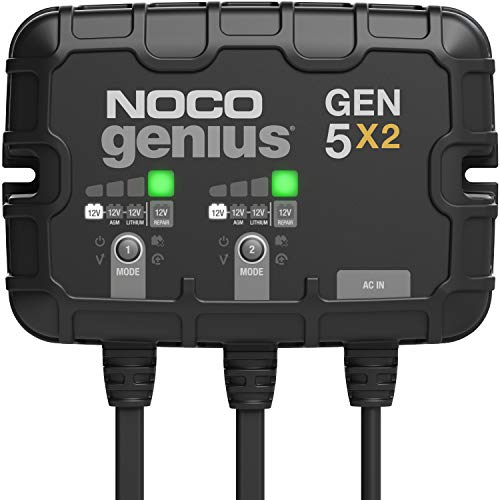
Best for: boaters with two 12V battery banks needing independent charging. The GEN5X2 delivers 5A per bank, supporting lead-acid and lithium chemistries with temperature compensation and overcharge protection. It is 37% smaller and 43% more powerful than earlier models, providing robust performance in marine environments.
Why chosen: The two-bank architecture allows simultaneous charging of two separate systems (house and starting battery, for example). Independent modes for 12V, AGM, Lithium, and Repair ensure precise maintenance across battery types.
Limitations: The unit targets 12V systems; ensure your battery setup matches the bank configuration and that your installation space can accommodate its size. While compact, the device still requires proper mounting and waterproofing considerations in open-water installations.
NOCO Genius GEN5X1: 1-Bank 5A Onboard Charger
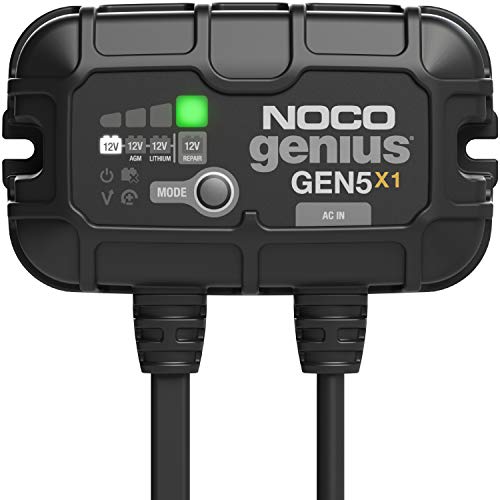
Best for: single-battery systems where space is limited or where only one 12V battery needs reliable maintenance. The GEN5X1 provides the same selectable modes (12V, AGM, Lithium, Repair) with a compact footprint.
Why chosen: For small boats or RV setups, a single-bank charger reduces wiring complexity while still offering temperature-compensated charging and overcharge protection. It’s a good upgrade from simple trickle chargers when a single bank suffices.
Limitations: Not suitable for users needing simultaneous charging of multiple banks or those with heavy-use dual-battery configurations.
Guest 2707A On-Board Battery Charger 8A / 12V

Best for: marine applications requiring IP67 waterproofing with dual independent banks. This model provides 8A total, with safety features such as reverse polarity, over-current, over-voltage, and over-temperature protection, suitable for rugged conditions.
Why chosen: The rugged design and dual-bank independence make it a solid choice for boats exposed to splash and humidity. It ensures each battery charges without interference from the other bank.
Limitations: Some users may want higher total amperage or more advanced lithium support; verify compatibility with your exact battery types before installation.
FirstPower Pro 2 Bank 5X2 Marine Charger

Best for: 12V marine and deep-cycle systems needing 24/7 charging with IP68 waterproof rating. It supports two banks at 5A each and handles SLA/AGM, Lithium, and Calcium chemistries with independent mode switching.
Why chosen: The 2-bank, 10A total configuration gives a versatile setup for boats that operate multiple battery needs while requiring robust sealing for continuous exposure to water and salt air.
Limitations: Ensure proper mounting and venting in restricted spaces; some installations may require additional hardware for secure mounting in highly vessel-specific layouts.
Buying Guide
- Bank count and total amperage: Choose the number of banks based on how many batteries you need to charge independently. More banks offer separate maintenance for house, starting, or deep-cycle batteries, but require more space and wiring.
- Battery chemistry support: Confirm compatibility with lead-acid (AGM, Gel, SLA), Li-ion/LiFePO4, and calcium batteries. Some models provide dedicated modes for each chemistry for safer charging.
- Waterproofing and ruggedness: Marine and RV environments demand IP-rated or sealed enclosures. Look for IP67 or IP68 ratings if the charger will be exposed to splashes or submersion risk.
- Mounting and installation: Direct-mount or surface-mount options affect where you can install the unit. Direct-mount models are convenient for under-hood or engine-bay placements, while surface-mount units fit flat dashboard or cabinetry spaces.
- Charging modes and maintenance: The ability to switch among 12V, AGM, Lithium, and Repair modes helps tailor charging to current battery health. Temperature compensation improves performance in varying climates.
- Safety features: Look for reverse polarity protection, over-current/over-voltage protection, and ignition protection where applicable. These reduce risk in tight or volatile environments.
- Future-proofing: If you anticipate expanding your battery fleet (more deep-cycle houses or LiFePO4 packs), prioritizing multi-bank and Li capable models can simplify upgrades later.
FAQ
- Do I need a separate charger for lithium batteries? Not always. Some onboard chargers support both lead-acid and lithium chemistries in separate modes, but verify that your specific battery types are listed in the product features.
- What is the advantage of a two-bank charger? It charges two independent batteries or sets of batteries simultaneously, reducing downtime and balancing maintenance between systems such as house and starting batteries.
- Can these chargers withstand saltwater exposure? Many marine chargers are designed for harsh environments with waterproofing standards, but installation location and enclosure still matter for longevity.
- Is higher amperage better for sailing or RVs? Higher amperage reduces charging time for large deep-cycle banks but may require more space and more robust wiring. Choose amperage to fit battery capacity and typical usage patterns.
- How do I choose between 1-bank and 2-bank models? If you only need to maintain a single battery or have space constraints, a 1-bank model suffices. For multiple batteries or separate loads, a 2-bank or higher is more practical.
- What maintenance mode should I use? Use Repair or Maintenance modes for aging batteries to optimize recovery and extend life, following the manufacturer’s guidelines for your battery chemistry.