Best Latches for Boat Compartments That Stand Up to Marine Conditions
When selecting boat compartment latches, pick options designed for durability, corrosion resistance, and reliable operation in marine environments. This guide highlights five top picks, each suited to different vessel types and storage needs. Best for daily boaters, best for saltwater yachts, best for RV or cabin storage aboard boats, best for lightweight or budget-conscious setups, and best for heavy-duty high-use hatches.
| Product | Best For |
|---|---|
| QWORK Boat Cam Latch | Small to mid-size boats needing precise fit and corrosion resistance |
| Thorn Boat Cam Latch (316 Stainless) | Saltwater boats and high-use hatches |
| Mudder Flexible Rubber Draw Latch | Cooler compartments, cargo boxes, and gear storage |
| Whitecap S-0226BC T-Handle Latch | Freshwater boats or light-duty cabin storage |
| MDEOOSKY 4Pcs Boat Latches | Budget-friendly, ready-to-install set for multiple compartments |
QWORK Boat Cam Latch, 2 Pack

Best for: small to mid-sized boats needing precise fit and a clear lock status. This latch is built from marine-grade 316 stainless steel, delivering corrosion resistance suitable for saltwater exposure. Its flush turning design minimizes snag hazards and supports a clean deck or hatch look.
- Precise fit: 52 mm (2.05″) hole cutout; panel thickness 1/2″–1″. Not for 2.5″ openings.
- Durable: Solid 316 stainless steel construction for corrosion resistance.
- Indicator: Red lock indicator and a flat lock range of 1-1/4″ to 2-3/4″ with 3 mm compression for a secure seal.
Best for: boaters prioritizing a secure, flush-mount latch with clear lock status. Can be a good upgrade for hatches, compartments, or deck storage where a robust, low-profile latch is preferred. Caution: do not use in openings outside the specified 2.05″ cutout range.
Whitecap S-0230BC T-Handle Latch – Non-Locking

Best for: freshwater vessels or light-duty storage compartments where locking is not required. The non-locking design reduces the risk of jamming in low-use applications and fits standard t-handle configurations.
- Feature: T-handle non-locking latch with neoprene o-ring for seal
- Dimensional note: Shaft length 3/8″ (approximate)
Caution: Because this is non-locking, it is best for areas where accidental opening is not a safety concern or where a simple, quick-release is acceptable.
Mudder 2 Pcs Flexible Rubber Draw Latch

Best for: cooler lids, cargo boxes, and front storage racks on boats where a flexible, corrosion-resistant latch is advantageous. The rubber draw latches come with a stainless steel keeper and bracket for added durability.
- Material: Flexible rubber with stainless steel keeper and bracket
- Size: Approximately 3.8″ long, 1.1″ wide
- Durability: Corrosion-resistant and lightweight, with long service life
Caution: Rubber components may degrade faster in extreme UV exposure; inspect regularly and replace as needed.
2 Pcs T-Handle Boat Hatch Latch With Keys
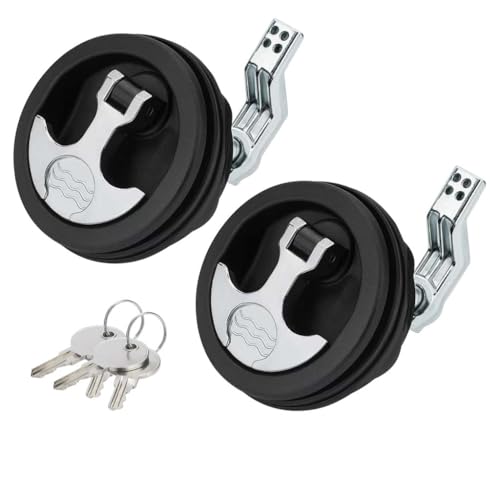
Best for: aluminum boats and budget-conscious setups needing a robust latch with key access. This kit uses a hybrid design combining a UV-resistant plastic body with a chrome-plated zinc alloy handle for torque strength.
- Hybrid durability: ABS body plus chrome-plated zinc alloy handle
- Fit: Universal 2-1/2″ cutouts; designed to solve “broken latch” issues
- Applications: Suitable for bass boats, pontoons, RV compartments, livewells, and baitwells
Caution: Verify hole cutout compatibility with your hull material to avoid fit issues on non-standard sizes.
Buying Guide
Key considerations to help you pick the right boat compartment latch:
- Material and corrosion resistance: For saltwater use, prioritize 316 stainless steel or other marine-grade metals to withstand corrosion and UV exposure.
- Locking vs. non-locking: Locking latches enhance security; non-locking models are simpler for quick access but can open unexpectedly in rough seas.
- Fit and compatibility: Check hole cutout diameter, panel thickness, and overall latch height to ensure a snug, watertight seal.
- Flush vs. protruding design: Flush designs reduce snag hazards and offer a cleaner deck appearance; protruding handles may be easier to operate with gloves.
- Weight and installation: Lightweight options reduce load on hatches; ensure mounting hardware and back plates are included or available separately for a secure install.
- Maintenance: Look for components that resist salt spray and mildew; periodic inspection helps prevent failure during trips.
FAQ
- What is the best latch material for saltwater boats?
316 stainless steel is highly resistant to corrosion in saltwater and is a common choice for marine latches.
- Should I choose locking or non-locking latches for deck compartments?
Locking latches are more secure for gear and valuables, while non-locking latches are suitable for quick-access storage in low-risk areas.
- How do I determine the correct latch size for my hatch?
Measure the hole cutout diameter and the panel thickness; ensure the latch’s dimensions match these specifications for a proper fit.
- Are rubber latches durable enough for marine use?
Rubber latches with stainless steel hardware offer good corrosion resistance but check UV exposure and replace when signs of wear appear.
- Can I install marine latches on aluminum hulls without galvanic corrosion?
Use latches with insulating bodies or hybrid designs to minimize galvanic corrosion on aluminum hulls.
- Do these latches require professional installation?
Most are designed for straightforward DIY installation with common tools, but follow manufacturer-specific instructions for best results.