Best Gas Boat Motors: Top Picks for Reliable Power on the Water
Gas outboard motors are a go-to choice for boaters who want strong, straightforward propulsion without the complexity of electric systems. This guide highlights five solid options, from compact 2.3HP models to more capable 6HP units, suitable for inflatable boats, dinghies, and small fishing craft. Each entry includes clear use-cases, advantages, and a practical caveat to help you choose.
| Product | Best For | Key Benefit |
|---|---|---|
| YIYIBYUS 2.3HP 52CC | Small boats, inflatable dinghies | Lightweight, efficient 2-stroke power |
| Gosangom 3.5HP 2-Stroke | Compact boats, kayaks | High torque with water-cooling |
| HinLIaDa 2.3HP 52CC | Inflatable boats, yachts | High efficiency and easy steering |
| BJTDLLX 6HP 2-Stroke | Fishing dinghies, small sport boats | Balanced power and durability |
| Baotree 4HP 4-Stroke | Compact sail/inflatable boats | Eco-friendly and easy handling |
YIYIBYUS 2.3HP 52CC Gas Outboard

Powerful for its class, this 2.3HP, 52cc two-stroke outboard delivers 4500-8500 rpm operation with a compact 0.22-gallon fuel tank. Built from aluminum and PP, it emphasizes corrosion resistance and durability. Best for small inflatable boats, dinghies, and light fishing craft that require reliable quick-start propulsion.
Who it’s for: Budget-conscious anglers and casual boaters with compact craft seeking a lightweight gas option. Why selected: Strong torque and efficient run time in a small package.
Caution: Two-stroke fuel mix at 25:1 must be maintained to prevent fouling and performance loss. Regular cleaning of the non-contact ignition helps avoid ignition issues.
4 Stroke 7.5HP Outboard Motor (200CC)
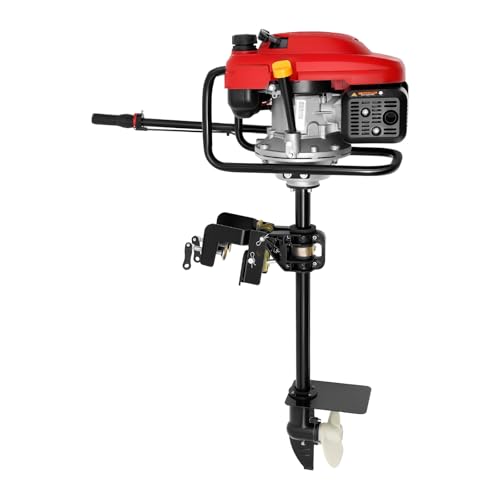
This 4-stroke, CDI-ignited motor offers up to 3.5 kW of power with a 3600 rpm peak. The design emphasizes smooth shifting through a continuous-gear design, good heat dissipation, and an efficient air-cooling system to prevent overheating on extended outings. Suitable for mid-sized dinghies and small boats where steady power and reliability matter.
Who it’s for: Boaters seeking a steady, mid-range powerplant with easier maintenance than some two-stroke rivals. Why selected: Combines stability with effective cooling for longer runs.
Limitation: Heavier than ultra-compact models, which can affect handling on very small craft.
Gosangom 3.5HP 2-Stroke Outboard

With a compact 36 x 14.17 x 5.9 inches footprint and a 21.6 lb weight, this 3.5HP model delivers up to 5000 rpm and 0.3 gal/hour fuel economy. Its aluminum alloy construction supports corrosion resistance in both fresh and saltwater environments. The short shaft design suits smaller craft like rubber boats and kayaks.
Who it’s for: Light, portable power needs for short-distance trips. Why selected: Excellent balance of power, portability, and fuel efficiency.
Caution: Being a 2-stroke engine, it requires proper fuel oil mix and maintenance to prevent performance issues.
HinLIaDa 2.3HP 52CC Outboard
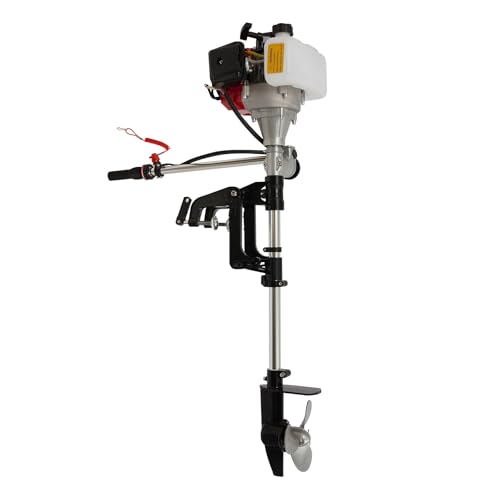
A lightweight 2.3HP, 52cc two-stroke outboard built from aluminum and PP for durability and corrosion resistance. It operates at 4500-8500 rpm with a robust 1.7 kW output. The wide steering angle (over 120°) enhances maneuverability, making it a practical option for inflatable craft and small boats.
Who it’s for: Operators prioritizing easy steering and efficient performance on tight water. Why selected: Strong steering capability on a compact unit.
Caution: As with many two-stroke models, fuel mixing accuracy is important for longevity and performance.
BJTDLLX 6HP Outboard Motor

This 6HP two-stroke engine features water cooling and a CDI ignition system with a short shaft. It also offers 360° steering rotation and a built-in reverse capability to navigate tight spaces. The durable cast aluminum construction provides corrosion resistance for marine use.
Who it’s for: Fishermen and hobbyists needing more power for larger or heavier small boats. Why selected: High power-to-weight ratio with flexible steering options.
Limitation: Heavier than tiny 2.3HP units, which may require a stronger mount and handling on smaller craft.
Buying Guide
What size should you choose?
Smaller boats benefit from 2.3–3.5HP units for basic propulsion, while dinghies and small fishing boats may require 4–6HP for practical speed and maneuverability. Consider the hull weight, typical load, and desired top speed when selecting horsepower.
Two-stroke vs four-stroke
Two-stroke engines (faster starting, higher power-to-weight) are common in compact models but require oil mixing and more maintenance to avoid performance issues. Four-stroke engines are heavier but offer cleaner operation, simpler maintenance, and often better fuel efficiency on longer trips.
Fuel and maintenance considerations
For two-strokes, maintain the correct fuel-oil mix ratio (often 25:1). Regularly inspect cooling passages, carburetors, and spark ignition. For four-strokes, routine oil changes and air filter care are essential. Always store fuel safely and check for corrosion protection on aluminum components.
Engine mounting and shaft length
Shallow-water craft benefit from short-shaft models, while larger, deeper boats may need long shafts. Ensure the mount aligns with the transom height to prevent cavitation and improve thrust efficiency.
Reliability and service access
Choose models with accessible parts, straightforward ignition systems, and reputable service networks. Aligned with small craft use, look for engines with simple maintenance routines and widely available replacement parts.
Performance expectations
Expect 0–20 mph for tiny 2.3HP units on inflatable boats, and higher speeds with 3.5–6HP engines on small dinghies or light craft. Real-world speed depends on hull design, payload, and propeller choice.
Safety and operating environment
Operate in calm waters, wear life jackets, and be aware of fuel handling safety. Saltwater use requires careful rinsing and corrosion protection checks to extend engine life.
FAQ
- What type of boat is best with a 2.3HP gas motor? Small inflatable boats, dinghies, and kayaks that need light, responsive propulsion.
- Are 2-stroke motors harder to maintain? They typically require precise fuel mixing and periodic carburetor cleaning, but are lighter and often cheaper.
- Which motor is easiest to start? Four-stroke motors generally offer more straightforward starting and smoother operation in varied conditions.
- Can I use these engines in saltwater? Yes, but rinse and protect against corrosion after use; some models are more corrosion-resistant than others.
- Is short shaft better for my boat? If your transom height matches the shaft, a short shaft can reduce prop cavitation and improve efficiency.
- Do these engines require maintenance kits? Basic maintenance includes spark plugs, fuel filters, and carburetor cleaning; refer to each model’s service guidance.