Best Fresh Water Pumps for Boats and RVs: Reliable Onboard Water Pressure Solutions
When choosing a fresh water pump for a boat, RV, or marine setup, you want a unit that delivers consistent pressure, quiet operation, and reliable priming. The following selections are practical options for smaller vessels and off‑grid deployments. Each product is best for a specific use case, from compact boat showers to full-crew water systems. Below, you’ll find a quick comparison table and an in‑depth look at five top choices.
| Product | Best For | Key Strength |
|---|---|---|
| ECO-WORTHY 33-Series Industrial Water Pressure Pump | Compact boat or cabin refreshment systems | Smart pressure switch, auto on/off |
| SEAFLO 55 Series 12V RV Water Pump | Reliable off-grid freshwater delivery | High flow, NSF/UL standards |
| Gidrox 12V RV Water Pump, 4.0 GPM | Quiet, portable boat or camper setups | Low noise, self-prime |
| ECO-WORTHY RV Fresh Water Pump 12V | Smaller RV or sailboat systems | On-demand pressure, overload protection |
| Upgraded 12V RV Water Pump by hzhdven | High-demand showers and sinks | Seven‑gallon flow, 70 PSI |
ECO-WORTHY 33-Series Industrial Water Pressure Pump
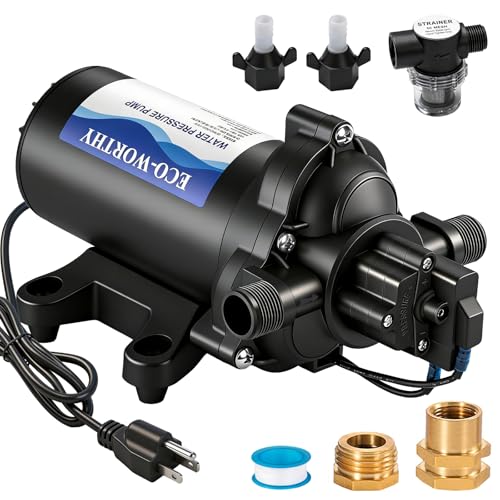
The 110V AC diaphragm pump provides a 4.0 GPM flow with a 50 PSI cut‑in. It’s designed for on‑demand operation via a smart pressure switch, which turns the pump on when water is drawn and off when faucets close. It runs quietly and includes a wide adjustable pressure range (45–70 PSI). It’s self‑priming up to 9.8 ft and can lift water up to 131 ft, making it suitable for cabin or boat installations that don’t rely on a battery. A thermal overload protector helps prevent motor damage. Best for boats or campers needing a shore‑powered solution without battery management. Caution: 110V supply required; keep in mind the 50 PSI preset range may need field adjustment for certain fixtures.
Gidrox 12V RV Water Pump, 4.0 GPM

This 12V diaphragm pump delivers 4.0 GPM with a 45 PSI shut‑off. It’s engineered for off‑grid use, featuring overheating protection up to 158°F and a noise‑reduction design with a vibration‑damping base, producing about 40 dB. Self‑priming up to 10 ft and capable of long‑line feeding (up to 100 ft head) make it dependable for RVs and small boats. Best for quiet camp setups where power from a battery or shore source is available. Limitation: 4.0 GPM may be modest for large showers or multiple fixtures simultaneously.
ECO-WORTHY RV Fresh Water Pump 12V DC

This 12V pump provides 3.5 GPM at about 45 PSI with a self‑priming capability up to 9.8 ft. It features an automatic pressure switch that starts and stops with faucet use and offers an adjustable 35–80 PSI range. Thermal overload protection adds safety, and the unit is designed to run dry briefly without damage. Best for compact RVs or sailboats where shore power or battery power is readily available. Caution: 3.5 GPM is best for limited fixtures; consider higher flow if you need simultaneous showers or multiple outlets.
Upgraded 12V RV Water Pump, 7GPM 70PSI (hzhdven)

This five‑chamber diaphragm pump delivers 7 GPM at up to 70 PSI, designed for heavy‑duty RV and marine use. It uses a smart automatic pressure switch to sustain steady pressure and reduce cycling. Self‑priming up to 10 ft and a durable build support off‑grid or shore power operations. Best for high‑demand setups like multiple fixtures with consistent pressure. Limitation: higher flow can demand more electrical current and a robust power source; ensure your battery and wiring can handle the load.
Buying Guide
What pump type fits your boat or RV?
Diaphragm pumps are common for marine and RV use due to their reliability and self‑priming capability. They handle raw water and varying pump demands well. Consider whether you need 12V DC operation (for off‑grid use) or AC power (for docked shore power).
What flow rate and pressure do you need?
For small cabins or boats with a single faucet, 3.5–4.0 GPM at 45–60 PSI is usually sufficient. For showers or multiple outlets, consider 5.0–7.5 GPM with 60–70 PSI. Smart pressure switches help maintain consistent pressure while reducing wear.
Installation and wiring considerations
Ensure you have accessible power sources and adequate fuse sizing. Self‑priming capability is important if the pump projects are higher than the water source. Check for compatibility with existing hoses and fittings; some models include adapters or connectors in the kit.
Noise, durability, and safety
Low‑noise designs and vibration dampening contribute to comfortable use on board. Overload protection and dry‑run tolerance protect the motor in variable conditions. NSF/UL standards can signal suitability for potable water systems in RVs and boats.
Maintenance and longevity
Regular inspection of fittings, seals, and the pressure switch helps prevent leaks and pressure loss. Self‑priming efficiency can decline if intake lines are restricted or air leaks occur. Choose models with accessible service parts if you plan long‑term use.
What should you avoid?
Avoid high‑mounted water tanks without adequate priming ability. Also avoid pumps with insufficient head pressure for your boat’s height or with poor compatibility with your water lines and fittings.
Summary of best fits
- Best for shore‑power boats: ECO-WORTHY 33-Series — compact, auto on/off, 110V.
- Best for quiet off‑grid RVs: Gidrox 12V 4.0 GPM — low noise, self‑prime.
- Best for reliable RV/marine duty: SEAFLO 55 Series — NSF/UL compliant, good flow.
- Best for small setups: ECO-WORTHY 12V 3.5GPM — automatic pressure, overload protection.
- Best for high demand: Upgraded hzhdven 7GPM 70PSI — strong flow, high pressure.
FAQs
- What is the typical pump flow for a marine freshwater system? Answer: Most small boats use 3.5–7.5 GPM depending on the number of outlets and fixtures.
- Do I need a self‑priming pump for a boat? Answer: Yes, self‑priming ability helps with variable water source heights and ensures consistent priming without manual bleeding.
- Can these pumps run on an RV battery? Answer: Many models are 12V DC and can operate from standard RV batteries with appropriate wiring and fusing.
- Is a higher PSI always better? Answer: Higher pressure is useful for certain fixtures, but excessive PSI can waste energy and stress fittings; select a unit with a suitable range for your setup.
- Are these pumps safe for potable water? Answer: Some pumps are designed to meet potable water standards; verify NSF/UL certifications for your chosen model.
- Should I choose AC or DC pumps? Answer: DC pumps are ideal for off‑grid or RV use; AC pumps suit shore‑power situations where a battery is not required.