Best Outboard Motors for Fishing Boats: Top 5 Options for 2026
Answering the question: the best fishing boat with an outboard motor depends on your boat size, water type, and cruising needs. This guide highlights five solid 2-stroke and 4-stroke outboard options that suit small fishing boats, inflatables, and kayaks, with notes on who each model is best for. Whether you need lightweight portability, strong speed, or fuel efficiency, these picks help you compare power, weight, and reliability at a glance.
Quick comparison of selected products:
| Product | Engine Type | Power (HP) | Best For |
|---|---|---|---|
| LIWBYYG 18HP Outboard | 2-Stroke | 18 | Small to mid-size boats, water enthusiasts seeking speed |
| DUIBAII 18HP HangKai | 2-Stroke | 18 | Freshwater or saltwater use, long runs with external tank |
| NAZEAOB 18HP Outboard | 2-Stroke | 18 | Heavier loads up to 2,204 lb, versatile boat sizes |
| FXEIPOL 9HP Outboard | 4-Stroke | 9 | Inflatables, kayaks, canoes, quiet and efficient cruising |
| BJTDLLX 6HP Outboard | 2-Stroke | 6 | Compact boats, dinghies needing easy maneuverability |
LIWBYYG 18HP Outboard Motor

Selected materials and noise management are key features of this motor. It uses lightweight aluminum alloy with corrosion resistance for both fresh and salt water. A large muffler reduces noise to around 80 decibels, helping you stay aware of activity on the water while enjoying smoother operation. This model is best for boaters who want a balance of light weight, speed, and reliability for regular day trips.
- Best for: Small to mid-size fishing boats that require a lively pace with manageable weight.
- Why selected: High power-to-weight ratio and robust heat and impact resistance for mixed water conditions.
- Limitation: As a 2-stroke, fuel efficiency may be lower than some modern 4-stroke counterparts.
DUIBAII 18HP HangKai Outboard

This 18HP HangKai model offers a 2-stroke engine with a maximum of 13.2 kW and a 5500 rpm ceiling. It features a water cooling system and CDI ignition for reliable starts. The external fuel tank option supports longer trips, with a practical fuel economy profile for extended outings.
- Best for: Boaters seeking strong acceleration and a dependable 18HP option for longer days on the water.
- Why selected: Combines a compact build with efficient fuel use and a robust cooling system.
- Limitation: External fuel tank compatibility varies by setup; verify fitment for your vessel.
BJTDLLX 6HP Outboard Motor

This 6HP motor is designed for inflatable boats and small dinghies. It includes a 360° steering rotation, allowing easy maneuvering in tight spaces. The unit uses corrosion-resistant cast aluminum and offers forward, neutral, and reverse settings, with a built-in tank and an external tank option depending on configuration.
- Best for: Inflatable boats and small craft that require precise, easy steering and minimal footprint.
- Why selected: Lightweight with versatile steering and solid corrosion protection.
- Limitation: Lower horsepower means slower top speed on heavier loads.
FXEIPOL 9HP Outboard
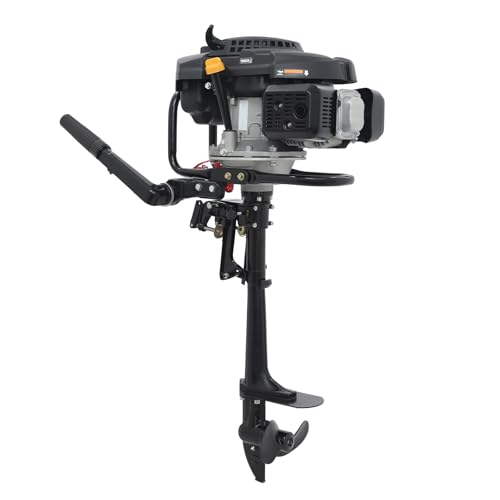
This 4-stroke outboard delivers 9 HP from a 224cc engine with a 4-stroke design, intended for inflatable boats, kayaks, and canoes. It emphasizes durability with aluminum construction and includes CDI ignition. Tilt functionality and a 180° reverse engage feature aid maneuvering in various watercraft sizes.
- Best for: Smaller watercraft needing reliable power without high fuel consumption.
- Why selected: Strong balance of power, durability, and user-friendly controls.
- Limitation: Lower horsepower compared to larger two-stroke options; may not suit heavier loads or faster speeds.
Gbonklong HANGKAI 6HP Outboard

This 6HP Y-rated outboard uses a 102cc engine with water cooling. It features a 7-inch three-blade propeller and corrosion-resistant aluminum construction. It is designed for inflatable and rubber boats, offering a compact and efficient option for short-distance cruising.
- Best for: Small inflatable or rubber boats needing light, reliable propulsion.
- Why selected: Good corrosion protection and fuel efficiency for short outings.
- Limitation: Heavier loads or larger boats may require more power.
Buying Guide: Key Purchase Considerations
- Boat size and weight: Match horsepower and engine weight to your craft’s capacity and intended loads.
- Fuel system: Consider whether you prefer an external tank option and fuel efficiency for longer trips.
- Engine type: Two-stroke motors offer higher power-to-weight but may be less fuel-efficient; four-stroke engines tend to be quieter and cleaner but heavier.
- Cooling and ignition: Water cooling and CDI ignition improve reliability, especially in saltwater conditions and with repeated starts.
- Propeller size: A larger 8-inch three-blade propeller reduces water resistance and improves acceleration, whereas smaller props suit lighter boats.
- Durability and corrosion resistance: Aluminum alloys with proper coatings help in freshwater and saltwater use.
- Maintenance access: Look for models with accessible service points and clear instructions for winterization in colder climates.
- Mounting compatibility: Verify transom compatibility, shaft length, and mounting hardware with your boat.
Frequently Asked Questions
- What size outboard do I need for a small fishing boat?
Answer: It depends on boat weight and desired speed. Common options range from 6 to 18 HP for small boats and inflatables; choose higher power for heavier loads or faster cruising. - Should I choose a 2-stroke or a 4-stroke?
Answer: 2-strokes are lighter and often provide more power for the weight, while 4-strokes are quieter and more fuel-efficient for longer trips. - Is external fuel tank compatible with all motors?
Answer: External tanks are common but verify compatibility with your engine model and mounting configuration. - Do outboards require special maintenance for saltwater use?
Answer: Yes. Rinse with freshwater after saltwater use, check anodes or corrosion protection, and perform regular fuel and oil inspections. - Can I install an outboard motor on an inflatable boat?
Answer: Yes, many models are designed for inflatable boats, but check the payload, transom compatibility, and mounting hardware for your model.