Best Electric Motors for Kayaks: Efficient, Quiet Propulsion for Flatwater Adventures
Whether you’re a casual paddler, a serious angler, or a remote-area explorer, an electric kayak motor can extend your range, boost speed, and reduce effort on long trips. This guide highlights five reliable choices and explains who each is best for. You’ll see options suited to saltwater use, lightweight portability, and longer-range performance. Use the quick comparison table below to compare key points at a glance.
| Product | Powers / Range | Weight | Best For | |
|---|---|---|---|---|
| Newport Kayak Series 36lb | 8 speeds (5F / 3R) | Lead-Acid 12V | Casual to moderate distance paddlers | Saltwater rated, telescoping handle |
| Bixpy K-1 Outboard Kit | 400 W, 33 lb thrust | ~10 lb motor + battery | Lightweight transport, versatile watercraft | Includes wireless remote |
| Newport NK300 | 1300 W peak, up to 6.5 mph | ~25.5 lb | Anglers and longer trips | Longer range up to 66 miles |
| 20PSI High Pressure SUP Pump | Not a motor—inflation system | ~3 lb | Kit for inflating boards | Auto-off; dual-stage |
| Newport Kayak Series 55lb | 8 speeds (5F / 3R) | Lead-Acid 12V | Saltwater use, heavier load | Saltwater rated |
Buying considerations include propulsion power, weight, battery compatibility, saltwater durability, and ease of mounting. The selections below frame each option by user need, from portability to endurance, so you can pick a motor that fits your kayak and typical trips without overpaying for features you won’t use.
Newport Kayak Series 36lb Thrust Trolling Motor
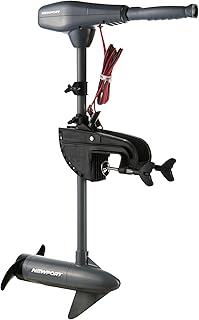
This transom-mounted motor delivers 36 pounds of thrust with eight-speed control (five forward, three reverse). The 24-inch fiberglass shaft supports variable depth placement for different hulls and setups, while the all-aluminum motor head and corrosion-resistant hardware are designed for saltwater environments. It is best for casual to mid-range trips where predictable power and reliable performance matter. Choose this if you kayak in sheltered bays or calm lakes and want a durable, affordable option with a straightforward control feel. A potential limitation is that lead-acid battery systems may be heavier and require more maintenance than newer lithium options.
Bixpy K-1 Outboard Motor Kit

The K-1 outboard kit combines a compact motor with a wireless remote and quick-release mount. At roughly 10 pounds for the motor and battery, it provides a high power-to-weight ratio with 400 W output and about 33 pounds of thrust overall. This setup is ideal for paddlers who want lightweight, mobile propulsion or to retrofit various watercraft like kayaks, paddle boards, or small inflatable boats. Best for: travelers who value portability and ease of mounting; avoid if you need longer continuous runtime without recharging, as battery life varies by usage and terrain.
Newport NK300 Electric Kayak Motor

The NK300 offers a 1300 W peak power rating with a compact, kayak-specific design at about 25.5 pounds. It emphasizes efficiency with a maximum range up to 66 miles and up to 30 hours of run time. This makes it well-suited for anglers and explorers who plan longer outings and want strong propulsion without excessive additional weight. Choose this if you need longer range, but be mindful of mounting space and battery management on smaller kayaks.
Newport Kayak Series 55lb Thrust Trolling Motor
This higher-thrust option follows the same 24-inch shaft design and saltwater-rated aluminum construction as the 36-pound model, but with more power for heavier loads or stronger currents. It’s best for heavier kayaks, rougher waters, or anglers who require stronger bite in windy conditions. A caution is that the increased thrust typically means higher battery consumption and might demand a larger battery setup or more frequent recharges.
Buying Guide: How To Choose The Right Electric Kayak Motor
What propulsion power do you need?
Power is a balance between payload, water conditions, and desired speed. For calm lakes and easy paddling, 30–40 pounds of thrust is often sufficient. For heavier boats, rougher water, or longer distances, 55 pounds or more can help maintain pace with less effort.
How important is weight and mounting?
Lightweight systems improve portability and mounting flexibility. If you travel by car or plane, a lighter motor like the Bixpy K-1 kit can simplify transport and setup. Heavier motors may require more robust mounting hardware and careful balance on the kayak.
What battery considerations matter?
Battery type (lead-acid vs. lithium) affects weight, range, and maintenance. Lead-acid systems are generally heavier and require more maintenance, while lithium batteries offer longer run time per pound. Check compatibility with your kayak’s battery connector and on-board electronics.
Is saltwater durability important?
If you kayak in saltwater, select a motor with corrosion-resistant hardware and a proven saltwater rating. Aluminum heads and stainless-steel components help resist corrosion but require proper rinsing after salt exposure.
What about noise and efficiency?
Whisper-quiet operation enhances wildlife viewing and fishing, while higher efficiency translates into longer trips between charges. Consider the motor’s duty cycle and how often you’ll need to recharge during multi-day outings.
Installation and compatibility
Ensure the motor is compatible with your kayak’s transom or mounting system. Some kits are universal, while others are designed for specific hulls or mounting configurations. Verify shaft length, tilt options, and available space on your kayak before purchase.
Frequently Asked Questions
- Can I use a kayak motor in saltwater? Yes, but choose models with saltwater-rated hardware and corrosion resistance.
- Which motor is best for long-range trips? Motors with higher thrust and efficient power use, such as NK300-style options, tend to provide longer range when paired with suitable batteries.
- Do these motors require a separate battery? Most do, and battery choice (lead-acid vs. lithium) will impact weight and runtime.
- Is installation difficult? Most systems offer straightforward mounting, but verify compatibility with your kayak’s transom and consider seeking professional installation if unsure.
- Are there lightweight, portable options? Yes, compact kits like the Bixpy K-1 are designed for easy transport and quick setup on multiple watercraft.
- What maintenance is needed? Rinse saltwater exposure after use, inspect bolts and seals, and store batteries per manufacturer guidelines.