Best 4 Channel Marine Amp Choices for Boat Audio Quality
Answering the question for boat owners and Marine audio enthusiasts: a 4-channel marine amplifier is ideal for powering a full range of speakers with clean, reliable sound in wet environments. The best picks below balance power, durability, and ease of installation. These models suit different buyers—from casual coastal cruisers to competitive wakeboard boat setups. The table at the top of this section highlights key specs for quick comparison.
| Product | Max Power | Channels | Ideal For |
|---|---|---|---|
| Skar Audio RP-150.4ABM | 1000W peak / 250W x4 @ 2Ω | 4 | Higher-volume crews seeking strong, full-range sound |
| Skar Audio RP-75.4ABM | 500W peak / 125W x4 @ 2Ω | 4 | Compact boats; budget-conscious upgrades |
| Pyle Hydra PLMRA402 | 400W peak / not specified | 4 | Entry-level marine systems with simple RCA inputs |
| Stinger MT-600.4M | 1000W peak / up to 250W x4 @ 2Ω | 4 | Rugged, space-limited installations |
| NVX VAD10004 v2 | 2000W peak / 150W x4 @ 4Ω, 250W x4 @ 2Ω | 4 | High-performance marine audio with flexible bridging |
Skar Audio RP-150.4ABM 1000W 4-Channel Marine Amp

This 1000-Watt MOSFET four-channel amplifier provides robust output for mid- to high-powered marine speaker setups. With RMS power ratings of 250W x 4 at 2 ohms and 150W x 4 at 4 ohms, it offers a strong balance of voltage headroom and efficiency in a marine-rated enclosure. Best for boaters who want clear, loud audio across multiple speakers without sacrificing reliability in damp environments.
Who it’s best for: owners upgrading a mid-sized boat’s sound system who need dependable four-channel output and straightforward installation. Why selected: it delivers substantial power while maintaining a more affordable price point than higher-watt alternatives. Caution: ensure your speakers are matched to 2Ω or 4Ω configurations to avoid overdriving components.
Skar Audio RP-75.4ABM 500W 4-Channel Marine Amp
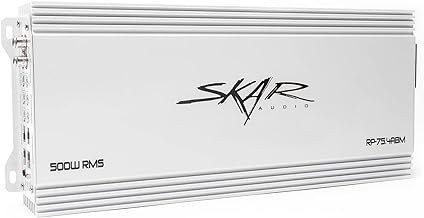
This 500-Watt class A/B four-channel amplifier is compact and light on power needs, delivering 125W x 4 at 2 ohms or 75W x 4 at 4 ohms. It’s well-suited for smaller boats or installations where space and power efficiency matter. Best for: buyers prioritizing a budget-friendly system with stable, reliable performance. Consider: lower overall output may require more efficient or higher-sensitivity speakers to achieve the desired volume.
Pyle Hydra PLMRA402 400W 4-Channel Marine Amp

This 4-channel amplifier is designed for straightforward marine audio upgrades. It offers 400W total output and provides RCA inputs for easier integration with many head units. Best for: entrants into marine sound upgrades seeking simple, reliable amplification with protective features. Limitation: data notes only basic protection features; ensure proper cooling and installation to prevent thermal issues in hot engine bays.
Stinger MT-600.4M Marine Amplifier

This Class D marine amplifier is engineered for boats and powersports, offering a compact footprint and sealed, water-resistant construction. It provides up to 250W x 4 at 2 ohms or 150W x 4 at 4 ohms, with a bridging option up to 500W x 2 at 4 ohms. Best for: installations with tight space or exposure to the elements where a rugged, efficient design matters. Caution: Class D efficiency can shift coupling with certain speaker types; choose compatible, efficient speakers for the best results.
NVX VAD10004 v2 4-Channel Marine Amp

The NVX VAD10004 v2 is a high-power 4-channel Class D amplifier rated for 2000W peak and 150W x 4 at 4 ohms or 250W x 4 at 2 ohms, with flexible high/low pass filtering and bass boost. Best for: users seeking strong, versatile marine amplification with sound shaping controls. Limitation: higher output requires careful electrical installation to manage heat and battery load. Bridging capability enhances flexibility for two-channel setups if needed.
Buying Guide
What to consider when choosing a 4-channel marine amplifier:
- Power needs: Match amplifier wattage to speaker impedance and desired listening level. Higher wattage is forgiving for dynamic peaks but requires adequate cooling and battery capacity.
- Impedance and wiring: Decide between 2-ohm or 4-ohm speaker configurations. Some amps provide stable output at both, while others excel at a specific range.
- Durability: Look for marine or weatherproof enclosures, corrosion resistance, and sealing against moisture and salt air.
- Inputs and compatibility: Ensure RCA or high-level inputs align with your head unit or source, and consider spectral filtering options (high-pass, low-pass) for better sound staging.
- Installation space: Consider footprint and mounting flexibility, especially on boats with tight consoles or engine compartments.
- Protection and safety: Note thermal protection and short-circuit protection to minimize electrical risks in marine environments.
Frequently Asked Questions
- What is a 4-channel marine amplifier best for? – It powers four speakers or two pairs with consistent power, ideal for front and rear boat speaker setups.
- Do I need a high-current battery or alternator with these amps? – Bigger power demands may require upgraded electrical system, especially with high-wattage models.
- What does Class A/B vs Class D mean for marine amps? – Class A/B delivers robust audio with higher fidelity for traditional setups; Class D is more efficient and compact, suitable for smaller spaces and higher power in open environments.
- Can I bridge a 4-channel amp for two-channel use? – Some models support bridging to 2-channel configurations; check the product specifications for each unit.
- Are marine amps corrosion-resistant by default? – Look for IP-rated enclosures or marine-grade materials to ensure longevity in saltwater settings.
- What should I know about speaker matching? – Pair amps with speakers that match or stay within the amp’s recommended impedance and power range to avoid distortion or damage.