Best 2.5 HP Outboard Motors for Small Boats
If you’re searching for a compact, reliable 2.5 horsepower outboard motor, you’ll find several strong options designed for small boats, canoes, inflatables, and fishing craft. These motors emphasize lightweight design, easy starting, and adequate cooling for short trips. They’re best for freshwater use, short cruising times, and budget-conscious boaters who still want dependable propulsion. Below, you’ll see five suitable models, with a quick comparison table and buyer-focused notes to steer your choice.
| Product | Horsepower | Best For | Key Benefit |
|---|---|---|---|
| 52CC Short Shaft 2.5 HP | 2.5 HP | Small boats under 9.8 ft | Fast cooling and strong RPM |
| 52CC 2.3 HP Outboard | 2.3 HP | Compact craft for short trips | Quick start and good heat dissipation |
| 2.5 HP Outboard with 0.32 gal Tank | 2.5 HP | Inflatables and kayaks | Visible fuel level, efficient operation |
| 4 HP Small Outboard | 4 HP | Inflatable and small boats needing extra power | Versatile steering and long endurance |
| 2.5 HP Outboard with CDI & Air Cooling | 2.5 HP | Inflatables and light craft | CDI ignition and quieter operation |
52CC 2.3 HP Outboard Motor 2 Stroke

Best for budget-minded anglers with small craft. This 2-stroke, 2.3-horsepower motor reaches up to 8500 rpm, enabling quick movement on short runs. It runs for approximately 40-70 minutes on a filled oil mix, making it suitable for brief fishing sessions or aquaculture checks. Its CDI ignition and hand-pull starter support a fast, reliable start. Use this model when you need a light, low-cost propulsion option for compact boats or raft setups.
The design emphasizes heat dissipation through housing cooling holes, aiding longevity during repeated use. This reduces the risk of overheating on short outings. Best for users who want a simple, no-fruss setup with straightforward maintenance, and who don’t require long endurance on lengthy trips.
Limitations: The absence of an external fuel tank means fuel management is manual, which may be less convenient for longer days on the water.
2 Stroke 3.5HP Outboard Motor

Best for small boats that need a bit more thrust without a large engine. This 3.5 HP motor delivers up to 5000 RPM with a streamlined three-blade propeller to reduce drag and improve cruising efficiency. It weighs around 21.6 lbs, making it portable for kayak or rubber-boat setups and simple to install. A CDI ignition and overheating protection contribute to safer operation on longer sessions.
Choose this if you want more propulsion power than the typical 2.5 HP class while maintaining compact size. It is well-suited for short trips on lakes and rivers where maneuverability and easy transport matter.
Limitations: Fuel economy is decent but not exceptional; expect more frequent refueling on longer river or lake excursions compared to larger engines.
52CC Short Shaft 2.5 HP Gas Outboard

Best for small, light craft under 9.8 ft that require efficient cooling and straightforward design. This model features a strong 2-stroke 2.5 HP motor capable of up to 8500 rpm, with a notable external fuel tank (0.26 gal) that offers a clear view of remaining fuel. Air cooling helps reduce overheating and keeps the engine running longer between refuels. The motor’s build combines plastic, aluminum, steel, and rubber for durability in saltwater and freshwater use.
Recommended for users who want visible fuel monitoring and a compact package with reliable performance in short-duration boating or aquaculture checks. It is best avoided for long trips where frequent fuel stops would be disruptive.
52CC Outboard Motor 2.5 HP With Air Cooling
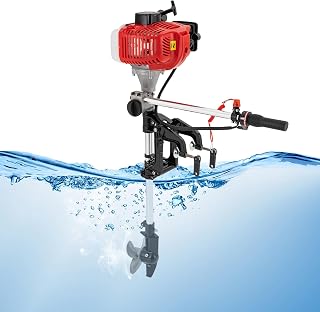
Best for enthusiasts seeking a lightweight, easy-starting outboard with CDI ignition and a quiet operation profile. This 2-stroke, 2.5 HP motor tops out around 6500 rpm and includes an external fuel tank (0.32 gal) for straightforward fuel management. A dedicated CDI ignition system simplifies starting, and a sound reduction feature helps maintain a calmer on-water environment. This makes it a practical choice for inflatable boats, dinghies, and small fishing craft where low noise is valued.
Limitation: The 6500 rpm ceiling is lower than some peers, so there may be a trade-off in top-end speed on demanding setups.
Buying Guide
What should you look for when choosing a 2.5 HP outboard motor for small boats?
- Boat size and weight compatibility: Ensure the engine shaft length and mounting match your boat’s transom and beam. Short shafts fit smaller craft, while mid or long shafts suit higher transoms.
- Starting mechanism: CDI ignition and manual pull starters offer reliability and quick starts in cooler conditions. Consider priming and ease of starting in cold weather.
- Cooling method: Air cooling is common for small engines and reduces overheating risk during short trips. Water cooling is generally less necessary at this power level but can improve endurance on longer runs.
- Fuel system and tank capacity: External fuel tanks simplify monitoring and refueling during trips. Look for visible fuel indicators and tank size that matches your typical trip duration.
- Weight and portability: Lighter units are easier to carry, install, and maneuver—useful for kayaks, inflatables, and dinghies.
- Maintenance and parts availability: Confirm that spare parts, cooling components, and ignition accessories are accessible in your region.
- Noise and vibration: Some models include a sound reduction feature, which is a consideration for anglers and quiet lakes.
Practical comparison notes
- Best for ultra-light boats: 52CC Short Shaft and 2.5 HP variants with external tanks offer easy handling and visible fuel levels.
- Better for longer sessions: 4 HP engines provide more endurance and a stronger propulsion option for canoes and inflatables.
- Choose this if you want quick starts: CDI ignition is present in several models and aids reliable starts in various conditions.
- Avoid this if you need high-end speed: Top RPMs are generally lower than larger 5–6 HP motors, which are not in this category.
FAQ
- Q: Are 2.5 HP outboards suitable for inflatable boats? A: Yes, many 2.5 HP units are designed for inflatables and small canoes, offering light weight and easy handling.
- Q: Do these motors require mixing oil with fuel? A: Some 2-stroke models require an oil-fuel mix; check the specific model’s requirements in the manual.
- Q: Can I use these motors in saltwater? A: Some models are designed for both saltwater and freshwater use, but always rinse and maintain after saltwater exposure.
- Q: What is the typical fuel tank size for these motors? A: External tank capacities vary; common options include 0.26 gal to 0.32 gal tanks for easy monitoring.
- Q: Is a long shaft necessary for small boats? A: For very shallow transoms, a short shaft often suffices; for higher transoms, a long or mid shaft may be required.
- Q: Do these motors include a reverse gear or steering assist? A: Many small motors use a basic steering handle and can support simple reverse maneuvers, depending on model.